Sunday, February 28, 2010


African Culture and Melville's Art: The Creative Process in Benito Cereno and Moby-Dick.
By Sterling Stuckey.

New York: Oxford University Press, November 2009. Paper:
ISBN: 0195372700, $27.95. 154 pages.
Review by Babacar M’Baye, Kent State University

American Culture and Melville’s Art: The Creative Process in Benito Cereno and Moby-Dick examines the relations between Melville’s aesthetics and African culture. While the critical literature about Melville is abundant, it usually eschews the significance of African traditions in the work of this complex American writer. American Culture and Melville’s Art focuses on three major books of Melville: Redburn: His First Voyage (1849), Moby-Dick (1851), and Benito Cereno (1855). According to Stuckey, interpreting these works’ relationships with African art will demonstrate that Melville was “a far more subtle and inventive writer than even the most fervent admirers” of these works “claim” (3-4).

Stuckey has always been interested in the connections between Africa and North America, as was apparent in the numerous times in which he hinted at them in his previous works such as Slave Culture: Nationalist Theory and the Foundation of Black America (1987) and Going through the Storm: the Influence of African American Art in History (1994). For instance, while discussing the African influence in Thomas Wentworth Higginson’s Army Life in a Black Regiment (1870), Stuckey suggests, in Slave Culture, Higginson’s fascination with the pervasive and ineradicable African-inflected “ring shout,” chants, rhythms, and feet and hand movements that blended with the Christianity of the Sea Island blacks during the Civil War (83-84). Discussing these Africanisms, Stuckey writes: “It should not surprise us that the same people constructed African huts in which they shouted and, as Higginson demonstrates in a passage that recalls Herman Melville’s Redburn, brought African sensibility to bear on Christianity” (84). A similar connection between Melville and African culture is apparent in Going through the Storm in which Stuckey reveals the ties between the African American folk figure Brer Rabbit and the character of Babo in Herman Melville’s 1855 tale Benito Cereno, whom he represents as a Senegalese. He writes: “The play of irony that informs Babo’s activities on board the San Dominick is precisely that adopted by Brer Rabbit in his African American expression . . . What is certain is that Babo is so much like Brer Rabbit that it is perfectly logical that he should have come from Senegal, a thriving center for tales of the African hare, Brer Rabbit’s ancestral model” (165).

Further connections between Melville and African traditions are also apparent in African Culture and Melville’s Art when Stuckey discussed how Melville’s knowledge of Africa mainly derived from the nineteenth-century philosophical and ideological scholarships about Africa that he read. In an attempt to refute the critic Edward Margolies’ argument that “Melville did not know blacks well” (37), Stuckey writes: “On the contrary, because he knew them well, Hegel was very useful as Melville imagined Don Benito’s dependence on Babo” (37). Stuckey continues: “Melville was almost waiting for Hegel to provide the philosophical terms for what he had long thought and espoused. Melville ties the slave trade to the wealth of England in Redburn, informing us that the wealth of Liverpool derived mainly from the slave trade, which underscore his command of the economics of master-slave relations” (37). As Stuckey argues, Melville’s knowledge of African culture is also evident in a passage in Benito Cereno in which a group of six enslaved Africans dance like “delirious black dervishes” (39). According to Stuckey, this example suggests “Melville’s recognition of abstruse aspects of Ashantee culture in [Captain] Delano’s account—the dance and music of the women” and “the best of his knowledge” of this culture (39).

Yet the strongest quality of Stuckey’s African Culture and Melville’s Art lies in the interdisciplinary methodology that he uses to suggest the links between Melville’s writings and Africa. This method is based on the use of the scholarship that might have influenced Melville before or as he was writing Moby-Dick, Redburn, and Benito Cereno. Drawing from this scholarship, which was usually and unarguably racist, Stuckey nonetheless shows its significance in the study of early African influences in early American writings which would have been difficult to corroborate without such historical documents. Two examples of such Africanisms appear in Stuckey’s analysis of Melville’s representations of non-Europeans in Benito Cereno and Moby-Dick. Discussing Benito Cereno, Stuckey refers to the personae of Atufal, Babo’s lieutenant, whose characterization was influenced by Joseph Dupuis’s description of Ashantee warriors in his Journal of a Residence in Ashantee (1824). Stuckey writes: “As we know, the royal gold, in Melville’s hands, became Atufal’s iron. The ‘iron collar’ about Atufal’s neck was derived from Dupuis’s reference to [Ashantee] warriors ‘armed and equipped in their full military habits; some with iron chains suspended round the neck’” (47).

In a similar vein, Stuckey shows that Melville’s description of “the carvings of flesh from the backs and thighs of Africans in Redburn” was an image that was initially reported in Captain Amasa Delano’s book A Narrative of Voyages and Travels in the Northern and Southern Hemispheres: Comprising Three Voyages Round the World; Together With a Voyage of Survey and Discovery, in the Pacific Ocean and Oriental Islands (37).

This book was first published in 1817 under the authorship of Amasa Delano, an American sea captain who was Born in Duxbury, Massachusetts, and served in the American Revolution as a soldier at fifteen and later as a “privateersman.” Stuckey includes this entire narrative in the last segment of African Culture and Melville’s Art, providing current scholars with an important text that can help to better understand the background that influenced Melville’s imagery of Africa in his writings, and his portrayal of the character of Captain Delano in Benito Cereno.

Additionally, Stuckey suggests the relations between Melville’s descriptions of the character of Atufal in Benito Cereno with his portrayal of the character of Daggoo in Moby-Dick. Stuckey writes: “Melville uses similar language in describing them—Atufal: ‘a gigantic black,’ ‘colossal form’; Daggo: ‘a gigantic, coal-black negro,’ ‘colossal limbs. . . . Daggoo’s ‘hearse-plumed head’ and Atufal’s death song, however, seal the argument” (48). By providing us with these parallels between Melville’s African and non-European characters, Stuckey suggests the strong impact of Africa in mid-nineteenth century American literary imagination. In this sense, African Culture and Melville’s Art compliments Toni Morrison’s Playing in the Dark: Whiteness and the Literary Imagination (1993), which also examines the representation of Africans in nineteenth-century American culture. In her book, Morrison explores the intricacies of White imagination of Blackness through her concept of “American Africanism,” that is, the study of the origins, literary uses, and constructions of the “African like (or Africanist) presence or persona” in the United States and “the imaginative uses this fabricated presence served” (6). In a similar vein, Stuckey explored the imagination of Africans in Melville’s writings and its derivation from the wider tradition of European ethnography of Africans that influenced it.

Another way in which Stuckey demonstrates the intricate relationships between Melville and Africa is through his analysis of the linkages between Moby-Dick and the Narrative of the Life of Frederick Douglas (1845). According to Stuckey, a major element in Douglas’s narrative is its allusion to slave dance and music that were heavily influenced by African traditions (82). As Stuckey suggests, the lyrics that Douglas heard on Colonel Lloyd’s Maryland plantation without largely referring to them were blues-like songs that “predated conventional spirituals” and “were difficult to grasp—perhaps owing to improvised, African-inflected song[s] intensified by the sheer agony of the slavery experienced” (82). As Stuckey points out, the shades of “sadness” and “joy” that Douglas reveals in the dance and music of the enslaved blacks might have influenced Melville’s representation of art in Moby-Dick (84). According to Stuckey, “Melville takes particular notice” of Douglas’s simultaneous expression of cheer and gloom in musical tones,” by “Using ‘gloomy,’ and ‘jolly’ as Douglas uses ‘sadness’ and ‘joy,’ to describe both music and the social condition that it reflects on the Pequod” (84). In this sense, Stuckey reveals the impact of both the slave narrative and African art in mid-nineteenth-century American literature.

Stuckey’s American Culture and Melville’s Art is a very important contribution to interdisciplinary scholarship because it establishes major connections between African culture and Melville’s Redburn: His First Voyage, Moby-Dick, and Benito Cereno. These influences demonstrate the pervasive imagination and representations of Africa in nineteenth-century American and European travel writings which provided Melville with the prism through which he learned about Africa. By considering these writings as vital historical and anthropological sources, Stuckey suggests the important role that interdisciplinary scholarships can have in the study of the relations between Africa and its parental cultures in the United States. As Stuckey points out, “the soul of the [American] nation is tied to that of black Africa” (82).

Sunday, November 29, 2009


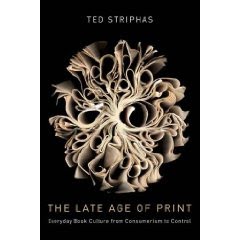
The Late Age of Print.

By Ted Striphas.

New York: Columbia University Press, May 2009. Cloth: ISBN 978-0231148146, $27.50. 272 pages.

Review by Vicky Gilpin, Millikin University, Illinois

An exploration of the lauded power of Oprah’s Book Club, the intricately planned scarcity of the Harry Potter series, and the concept of controlled consumption might appear to be disparate topics for a single book. Even some bibliophiles might pause when confronted with a book concerning the recent history of the book industry and book culture’s relationship with consumer capitalism. However, Ted Striphas’ compact The Late Age of Print: Everyday Book Culture from Consumerism to Control elegantly presents concepts of potential interest to most readers. He uses the evolution of book culture as a lens through which he examines readers as consumers and the power behind book-based capitalism. Neither nostalgic nor pedantic, Striphas documents how books became everyday objects, the industry behind publishing, and the transformation of consumerism.

The book examines and sometimes challenges commonly-touted beliefs, such as whether or not big-box bookstores truly have an impact on independent book sellers and whether Oprah’s Book Club has revolutionized the way people read. The work also includes a behind-the-scenes perspective of the exact process of ordering a book from Amazon.com as well as the security involved in the transportation of the final volume of the Harry Potter series. The combination of historical elements, scholarly analyses of cultural mores in regard to books, and interesting snippets of information create a tone of accessibility throughout the book.

The sources used to explore and promote the concepts of the work range from the seminal to the trendy. Striphas delves into a variety of source styles, from juried journal articles to television excerpts to policy contracts, in order to examine the nature and power of book culture. The work takes an almost phenomenological approach, as no source is lauded as being of higher worth or with more importance to the discussion than another, and all resources serve to further the book’s exploration. The meld of sources from popular culture with works of scholarly inquiry sets an inviting and accessible tone that does not devolve into unfocused pabulum.

Striphas presents concepts that lend themselves to future research in the form of questions within the chapters. The work serves as a succinct introduction to consumerism’s evolution as viewed through the lens of the book industry, but it also provides a persuasive goad for continued research on multiple topics. Potential research includes concepts of global cooperation in industry and in regard to intellectual property, the ebb and flow of the use of e-books, and increased research into the effects of big-box bookstores on independent bookstores. Another area for further exploration includes what literature classes could learn about understanding of readers and potential readers from the canny methods of Oprah’s Book Club. Finally, also relevant to the concepts in The Late Age of Print would be an analysis of what Stephenie Meyers’ choice to expose her partially-finished fifth book in the Twilight series online after a leak indicates about the relationship among created scarcity, authors, and readers.

Although the potential pedantry of the topic might be off-putting for some readers, the chapter introductions and summaries maintain a tight focus to ease a wide variety of stakeholders into the discussion. Readers adept at maneuvering through cerebral non-fiction, journal articles, and other scholarly works might find the repetition of focus within the chapters an unnecessary reliance on a traditional presentational style and redolent of academic submission formats. However, the repetition constantly hones the topic to provide a tighter emphasis on the topic while maintaining readability for a wide audience. Campus librarians, literature instructors, and recreational readers may find the work as beneficial as those readers involved in multiple facets of the book industry or researchers of popular culture, industrial trends, and the effects of cultural shifts on consumerism. The concise accessibility of the language invites readers to ponder the questions posited within the chapters as well as enjoy what might have become bland historical details in a lesser work; for example, the depiction of the development of the ISBN is fascinating.

The Late Age of Print allows readers to join Striphas in his examination of book culture, the transformation of modern consumption, and the desire among corporations for increased methods of awareness of book buyers as consumers.

Thursday, May 28, 2009


Harper Lee’s To Kill a Mockingbird: The Relationship between Text and Film
By R. Barton Palmer
London: Methuen Drama, December 2008. Paper: ISBN 978-0713679113, $19.95. 224 pages.
Review by Laurence Raw, Başkent University, Ankara, Turkey
If ever there was a book telling us everything we possibly wanted to know about Harper Lee’s classic – both book and film versions – it is this one. Exhaustively researched and written in a clear, accessible style, Palmer situates the novel in its context of production, and then explains why it has proved so enduringly popular since it first appeared in 1960. He describes it as “an indirect assault on the insufferable intolerance of Jim Crowism [….] [The novel] challenges, even if it does not overturn, conventional understandings of stable identity” (107).
Palmer subsequently discusses how Robert Mulligan’s 1962 film version departs significantly from the book. With Gregory Peck as the star, this was bound to happen: the character Atticus Finch was transformed into “[a] fair-minded Southerner” who, with the help of “fair-minded Northerners” would help to provide solutions to racial conflict (197). Lee does not say anything about Northerners influencing Southerners; nor does she even conceive of the South as a “social problem” seeking remedies from outside. However, the film version was rewritten to accommodate Peck’s sensibilities as a white liberal trying to cope with a fast-changing world. Despite such changes, Palmer argues, the film does not have an “adversarial relationship with the novel”; rather, it “has been generally understood as more a faithful homage [to Lee’s work] than a critique” (233).
Why should To Kill a Mockingbird have become so important in American literary and cinematic culture? Palmer suggests that Lee not only attacks Jim Crowism but also challenges the stereotype of a benighted and savage South. Frustrated by the close nature of Southern society, she tries to open it up, not only critiquing its racist assumptions, but showing its more positive sides too – for example, the belief in the family. Lee had a love-hate relationship with her culture; she wrote Mockingbird not in the small Alabama town where she grew up, but in New York City, where she moved to pursue her writing career. Only then did she acquire sufficient physical and emotional distance to recount a fictionalized version of her life (63). Palmer suggests that she not only depicts her childhood in an authentic manner, but also has a lot to say about the adult world of racial politics. This is what makes the novel so important for readers and teachers, many of whom identify Mockingbird as an essential part of their students’ moral education. Ex-President George W. Bush recognized Lee’s achievement by awarding her the Presidental Medal of Freedom in 2007.
In his account of the making of the film, Palmer shows how director Mulligan and producer Alan J. Pakula conceived it as a small-scale work, focusing in particular on personal relations and social customs. Peck agreed to be involved in the project as he believed that it would contribute to his reputation as a serious screen actor. He liked the part of Atticus, seeing in the character a reflection of his courage and desire to empathize with others (163). Palmer analyzes the screenplay in detail, showing how it evolved through various drafts, incorporating changes recommended by the star as well as the Catholic Legion of Decency (which still exercised considerable powers of censorship in the early 1960s). He shows how Peck was dissatisfied with early drafts of the script that did not present Finch in a sufficiently favorable light. After extensive rewrites, however, Peck’s concerns were allayed, and filming proceeded smoothly with very few technical hitches. When the film opened in late 1962, it was commended by Variety as “a major film achievement,” which vindicated Peck’s commitment to the project. Since then its reputation has increased with successive rereleases: Palmer notes that no one has ever tried to remake it, except for one misbegotten effort in 1997 which never achieved a general release.
To spend over two hundred pages discussing one book and one adaptation might seem like overkill. Far from it: Palmer not only offers new insight into how a classic film was constructed, but shows how adaptations can connect meaningfully and deeply to their sources. I recommend the book as an inspiring read not only for film buffs but for anyone reading or teaching the novel, regardless of educational level.

Saturday, August 23, 2008


from Palgrave Macmillan
The American Landscape in the Poetry of Frost, Bishop, and Ashbery
by Marit J. MacArthur

Friday, August 22, 2008

from University of Oklahoma Press
Legacies of Camelot
by L. Boyd Finch
under review by William Housel, Northwestern Louisiana State University

Tuesday, August 19, 2008

from University Press of Kansas
Future West: Utopia and Apocalypse in Frontier Science Fiction
by William H. Katerberg
under review by Katrina G. Boyd, University of Oklahoma
from Oxford University Press
Laughing Fit to Kill: Black Humor in the Fictions of Slavery by Glenda Carpio
under review by Ahati N. N. Toure, Delaware State University